Dusty air rises from the silo
During filling or pneumatic conveying, dust-laden venting air enters the collector through the bottom mounting flange.
Dust collection equipment for cement silos, concrete batching plants and bulk cement unloading.
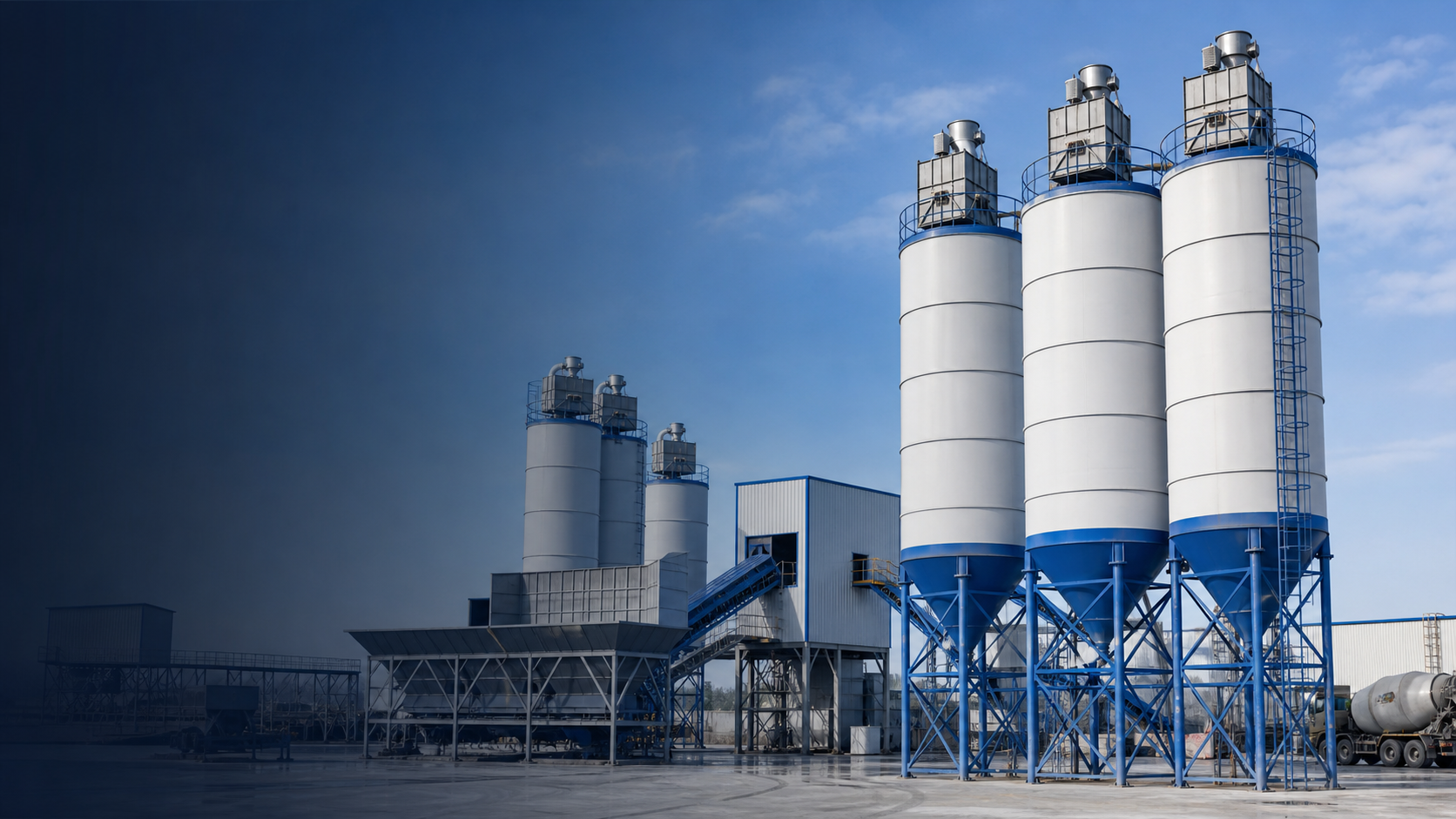
Cement Silo Dust Collector is used for dust collection and silo venting during powder storage, pneumatic conveying, truck unloading and bulk material handling. Dust is captured by filter bags or cartridges, and clean air is discharged through the top or outlet while collected dust falls back into the silo or hopper after pulse jet cleaning.
We supply standard model equipment and custom-built dust collectors according to airflow, filter area, material characteristics, silo size and installation conditions.
| Item | Typical Range / Options |
|---|---|
| Airflow | 270-10800 m3/h, custom by project |
| Filter Area | 9-90 m2; cartridge type 14 m2 or 24/24.5 m2 options |
| Cleaning Method | Automatic pulse jet cleaning |
| Cleaning Pressure | 0.4-0.7 MPa |
| Efficiency | 99%-99.9% depending on filter media |
| Material | Carbon steel, stainless steel or custom structure |
Filter area, body material, flange size, filter media, hopper design, fan position and control system can be customized.
230V/460V 60Hz motors, UL/CSA/ETL electrical components, anti-static filter media and explosion-proof options are available upon request.
Cement silos, fly ash silos, mineral powder silos, dry mortar plants, chemical powders, food powders and bulk material handling systems.
A process diagram based on the CTD silo-top structure: dusty venting air rises from the silo, filter bags capture powder, clean air exits through the fan or outlet, and pulse valves clean the bags so dust returns to the silo.
During filling or pneumatic conveying, dust-laden venting air enters the collector through the bottom mounting flange.
Dust stays on the outside of the filter bags while clean air passes through the filter media into the clean-air chamber.
Filtered air moves from the clean-air chamber to the side outlet or fan connection and is discharged outside the collector.
The pulse air header (气包) and solenoid pulse valves send short jets through blow pipes to clean the filter bags automatically.
After pulse cleaning, collected powder falls back through the bottom opening into the silo or bin.
The model name can be selected by filter area and checked against actual airflow and dust characteristics.
| Model | Filter Area | Suggested Airflow | Typical Application |
|---|---|---|---|
| CTD-9 | 9 m2 | 270-1080 m3/h | Small silos and small tanks |
| CTD-18 | 18 m2 | 540-2160 m3/h | Small cement and fly ash silos |
| CTD-24 | 24 m2 | 720-2880 m3/h | Regular cement and powder silos |
| CTD-27 | 27 m2 | 810-3240 m3/h | Medium powder handling |
| CTD-36 | 36 m2 | 1080-4320 m3/h | 100-ton cement silos and batching plants |
| CTD-45 | 45 m2 | 1350-5400 m3/h | Higher unloading rate silos |
| CTD-54 | 54 m2 | 1620-6480 m3/h | Large powder storage systems |
| CTD-72 | 72 m2 | 2160-8640 m3/h | Large silo top systems |
| CTD-90 | 90 m2 | 2700-10800 m3/h | Large cement silos and central dust collection |
Short practical answers about equipment selection, customization, installation and operation.
Yes. Filter area, material, flange size, filter media, voltage and control method can be customized according to working conditions.
Not always. Many silo top filters use silo pressure venting during pneumatic conveying. Fan-assisted designs are available for induced draft applications.
Yes. 230V/460V 60Hz power supply, UL/CSA/ETL certified electrical components and project-specific control panels are available upon request.
Airflow, silo size, material type, dust concentration, temperature, humidity, discharge method, filter area target and installation space are useful for selection.
Useful information includes silo size, material name, unloading method, airflow, required filter area, voltage, flange size, site space and any drawings or photos.
The cost depends on filter area, airflow, material, bag or cartridge filter type, pulse jet system, motor or fan configuration, electrical parts and customization level.
Yes. A single custom unit can be manufactured according to flange size, filter area, body material, installation height and electrical configuration.
Lead time depends on quantity, model size, surface treatment, special electrical parts and customization. Standard structures are usually faster than fully custom projects.
Yes. Basic outline drawings, flange dimensions and project confirmation drawings can be prepared before manufacturing when the buyer provides site requirements.
Yes. Jingfeng Environmental supplies Made in China dust collection equipment for global projects and can configure equipment according to overseas project requirements.
Ask about filter area, airflow, filtration velocity, filter media, pulse jet system, compressed air requirement, flange size, electrical voltage, spare parts, drawings, delivery time and packing.
Yes, but the quote will be more accurate if you also provide material name, filling method, unloading rate, dust concentration, site voltage and flange dimensions.